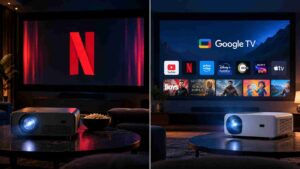
Projector vs TV — it is one of the most common questions we get at Digital
Minds India. If you are planning a home theatre setup in India and trying to
decide between a large screen TV and a smart projector — this guide will give
you a clear, honest answer based on real-world experience.
The short answer: for screen sizes above 100 inches, a projector wins
on every metric — price, picture size, portability and value for money.
For screen sizes under 65 inches in a well-lit room, a TV may be more
practical. But the full picture is more nuanced — read on for a complete
comparison.
Projector vs TV — Quick Comparison
| Factor | Projector | TV | Winner |
|---|---|---|---|
| Screen size for ₹10,000–₹20,000 | 100–230 inches | 32–55 inches | Projector ✅ |
| Picture quality in dark room | Excellent | Excellent | Tie |
| Picture quality in bright room | Good (high lumens) | Excellent | TV ✅ |
| Cinematic experience | Exceptional | Good | Projector ✅ |
| Eye comfort — long sessions | Better (reflected light) | Good (direct emission) | Projector ✅ |
| Gaming performance | Good | Excellent (low latency) | TV ✅ |
| Portability | Excellent | Poor | Projector ✅ |
| Installation flexibility | Excellent | Limited | Projector ✅ |
| Smart features | Android OS — full OTT access | Smart TV OS — full OTT access | Tie |
| Sound quality built-in | Basic | Better | TV ✅ |
| Long-term maintenance | LED — zero maintenance | Zero maintenance | Tie |
| Value for money | Exceptional | Good | Projector ✅ |
Screen Size — Where Projectors Win Completely
This is where the projector vs TV debate is decided for most
Indian buyers. Consider these numbers:
| Budget | Projector Screen Size | TV Screen Size |
|---|---|---|
| ₹8,000–₹10,000 | 100–230 inches | 32 inches |
| ₹15,000–₹20,000 | 150–200 inches | 43–50 inches |
| ₹30,000–₹50,000 | 200+ inches (4K) | 55–65 inches |
| ₹1,00,000+ | 200+ inches (laser 4K) | 75–85 inches |
A 150-inch TV costs upwards of ₹10 lakhs in India. A projector
delivering a 150-inch screen costs ₹14,000. The screen size
advantage of a projector at any budget is simply impossible
to match with a TV.
For true home cinema — where immersion in the film is the goal —
screen size matters more than almost any other specification.
A 150-inch projected image in a dark room is a fundamentally
different and more cinematic experience than even the best
65-inch TV.
Picture Quality — The Honest Truth
This is where TV manufacturers will tell you TVs win — and they
are partially right, but only in specific conditions.
In a Dark Room
In a properly darkened room a good smart projector delivers
picture quality that is indistinguishable from a TV for most
content. Modern LED projectors with Full HD resolution, 4K
decoding and high contrast ratios produce vibrant, sharp
and detailed images that are genuinely impressive for
movies and OTT streaming.
In a Bright Room
This is where TVs have a clear advantage. TVs produce direct
light — the brighter the room, the better a TV looks. Projectors
use reflected light — ambient light washes out the projected
image. High-brightness projectors (10,000+ lumens) significantly
reduce this limitation but cannot fully match a TV in a
sunlit room.
Practical implication for Indian homes: Most
Indian families watch TV in the evening and at night — in
reduced or low light. In these conditions a projector
performs excellently. Only buyers who need a screen for
bright daytime use in a sunlit room without curtains
should strongly consider a TV over a projector.
Eye Comfort — A Significant Advantage for Projectors
This is an underappreciated advantage of projectors that
genuinely matters for long viewing sessions — movie marathons,
cricket matches, extended gaming.
TVs emit direct light — the screen itself produces the light
that enters your eyes. This direct emission causes eye fatigue
during long sessions, particularly in dark rooms where the
bright TV screen contrasts sharply with the dark surroundings.
Projectors use reflected light — the projector throws light
onto a wall or screen which then reflects it to your eyes.
Reflected light is inherently softer and more natural —
similar to how sunlight reflects off surfaces in the
real world. Eye strain during long projector viewing
sessions is significantly less than equivalent TV viewing.
For families with children who watch extended content,
for movie enthusiasts who enjoy long sessions, and for
anyone prone to eye fatigue — this is a meaningful
real-world advantage of projectors.
Gaming — TV Has the Edge
For competitive gaming — especially fast-paced games where
input lag matters — a gaming TV or monitor has a clear
advantage over a projector. Most smart projectors have
input lag in the range of 50–100ms which is noticeable
in fast-paced competitive gaming.
However for casual gaming — RPGs, sports games, adventure
games — where input lag is less critical, gaming on a
200-inch projected screen is an experience that no TV
can replicate at the same budget. There is simply no
comparison to playing FIFA or Call of Duty on a
150-inch screen.
Our recommendation: serious competitive gamers should use
a dedicated gaming monitor or low-latency TV. Casual
gamers who want the most immersive experience possible
should choose a projector.
Smart Features — Equal in 2026
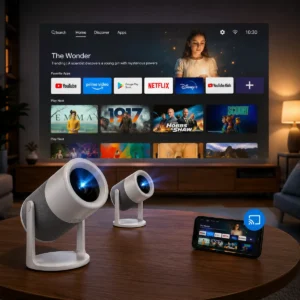
This used to be a TV advantage — not anymore. Modern smart
projectors like the ZEGO range run Android OS giving direct
access to Netflix, YouTube, Amazon Prime Video, Disney+
Hotstar, ZEE5, SonyLIV and every major OTT platform.
The experience is identical to a Smart TV.
Screen mirroring from phones, tablets and laptops via
AirPlay and Miracast, Bluetooth speaker connectivity,
HDMI input for gaming consoles — modern smart projectors
match Smart TVs feature for feature in 2026.
Sound Quality — TV Wins on Built-in Audio
Built-in TV speakers are generally better than built-in
projector speakers — TVs have more internal space for
larger speaker drivers and better acoustic chambers.
However this advantage disappears the moment you connect
an external speaker. A ₹2,000–₹5,000 Bluetooth soundbar
connected to a projector via Bluetooth or 3.5mm audio
out delivers significantly better audio than even a
₹50,000 TV’s built-in speakers.
For a true home theatre setup — whether projector or TV —
an external sound system is always recommended. On this
basis the built-in audio difference becomes irrelevant.
Portability — Projectors Win Completely
A smart projector weighing under 1kg can be moved
between rooms in seconds, taken to a friend’s house,
carried on trips, set up for outdoor movie nights in
the garden or terrace, and packed away when not in use.
A TV — even a small one — is a fixed installation.
Moving it requires unmounting, disconnecting cables,
carrying a heavy panel and remounting. For Indian
families living in rented homes, in joint family
setups with shared spaces, or who want flexibility —
the portability of a projector is a significant
practical advantage.
Which Should You Buy? — Our Recommendation
Choose a Projector if:
- You want the largest possible screen for your budget
- You primarily watch in evenings or with curtains drawn
- You want a cinematic home theatre experience
- You need portability — rented home, shared spaces, travel
- You have long viewing sessions — eye comfort matters
- You want to watch movies and OTT content on
a massive screen - Your budget is under ₹20,000
Choose a TV if:
- You need a screen in a bright sunlit room
without curtain control - You are a competitive gamer where input
lag is critical - You want a permanent fixed installation
in a living room - Your primary use is news, sports and
casual TV channel viewing - Screen sizes of 43–65 inches are sufficient
for your needs
Best Smart Projectors to Buy in India — Digital Minds India
If you have decided a projector is right for you — here are
our top recommendations at every budget:
- ZEGO A002 — ₹8,499 —
best projector under ₹10,000 — 230-inch projection,
Android 9, Auto Focus - ZEGO A004 — ₹7,999 —
best for iPhone users — Android 11, AirPlay,
dual stereo speakers - ZEGO X1 — ₹13,999 —
best projector under ₹15,000 — Full HD 1080p,
2GB RAM, dual HDMI - ZEGO P1 — ₹17,500 —
best premium pick — Full HD 1080p, 4000:1 contrast,
Auto Focus, 6D Keystone
All projectors come with fast Pan India shipping,
100% genuine products and a 6-month warranty.
Need help choosing? Call +91 8287463377
or WhatsApp +91 9988767993 —
Monday to Saturday, 11am to 7pm.
Frequently Asked Questions
Q. Is a projector better than a TV for home
theatre in India?
For screen sizes above 100 inches and evening viewing
in a darkened room — yes, a projector is significantly
better value than a TV for home theatre in India.
A ₹14,000 projector delivers a 150-inch screen that
would cost ₹10+ lakhs as a TV.
Q. Can a projector replace a TV completely?
For most Indian families who primarily watch in the
evenings — yes. A smart projector with Android OS
covers all OTT streaming, HDMI connectivity and
smart features of a Smart TV, with a dramatically
larger screen at a fraction of the cost.
Q. Which is better for eyes — projector or TV?
Projectors use reflected light which is easier on
the eyes than the direct emission light of TV screens.
For long viewing sessions, projectors cause
significantly less eye fatigue than TVs.
Q. What is the minimum room size for a home
theatre projector?
Most smart projectors can project a 100-inch screen
from just 2.5–3 metres. A standard Indian bedroom
(10×12 feet) is sufficient for a 100-inch home
cinema setup with a smart projector.
Q. Is projector good for watching cricket
in India?
Absolutely — watching cricket on a 150–200 inch
projected screen is an experience that no TV can
match. The large screen makes every boundary,
wicket and six significantly more exciting.
High-brightness projectors like the ZEGO X1
and P1 (12,500 lumens) work well even with
some ambient light during afternoon matches.
Q. Which smart projector should I buy
for home theatre in India?
For the best home theatre under ₹15,000 —
the ZEGO X1 at ₹13,999 is our top recommendation.
For the best premium home theatre under ₹20,000 —
the ZEGO P1 at ₹17,500. Both are available at
Digital Minds India with 6-month warranty and
fast Pan India shipping.